Minggu, 21 Februari 2010

DSW in DC is the Sculpture Garden Ice Rink

On the first weekend without snow on sidewalks in the DC area in a long, long time, I jammed my feet into overused skates, with their dull edges and ratty laces, and sashayed around the National Gallery's Sculpture Garden ice rink without falling. I actually enjoyed being outside in the mid-40s; however, my sister was quick to reminded me that LA weather allows her to enjoy the beach in February. Whatever.

I got in the ticket line around 3:45 p.m. for the 4-6 p.m. session. Of course that session sold out before I could get my ticket so I stayed in line for the 5-7 p.m. session and warmed up in the sculpture garden's pavilion eatery. Suddenly paying $7 for a garden salad didn't seem so bad when it came with heat, glorious heat. As cheapo depot, I just sat a table reserved for customers and left with the same amount in my wallet as I had coming in.

Another thing off my DC bucket list.

Within minutes, the line for skate rentals reach 1/3 of the way around the rink so I left the warmth to grab my spot. I struck a conversation with some folks in line and realized that everyone skating here is required to say that they haven't skated in at least 10 years as the woman and her daughter said they haven't skated in 17 years. Quite an exact number.

I grabbed my skates and started laced them twice for maximum ankle stability that made no difference in the quality of my skating, but the piece of mind was nice. I talked to the folks on the bench across from me who hadn't skated in 14 and 11 years. Of course they hadn't in 10+ years.

Plenty of free shoes to take in the heart of DC. I'm not sure taking this picture was worth the strange looks I received.

One woman stopped after a few laps because her ankles hurt while her friend, who owned skates, said it was a good idea to stop because the ice rink was small, the surface was awful, and "people are out of control out there." Thanks for the reassurance before I head out. Sure sounds like a swell time! What a way to sell the experience I already paid for.

I rammed my shoes in a locker that was designed using the Smithsonian's collection of foot binding shoes. The lockers were raggedy and made me wonder if the peeling paint gave me a dose of lead for good measure. It was still worth knowing that my shoes were safe instead of leaving them under the benches and walkway. A locker's only $0.50 so why risk things to a rogue criminal with a shoe fetish.

Size 12 sneakers don't fit in the lockers nicely.

I walked to the ice and joined the parade of skaters, circling counter-clockwise like vultures over the carcass of a metro DC resident's bucket list - mine. I was finally skating in DC. I skated five years ago, but didn't want to be called out so I was ready to say it had been 15 years if anyone asked.

The flock of blades tore the ice and made it bumpy after 10 minutes of laps. At times my blade struggled to push off the slush, but come on, I'm slowly skating on the Mall! It's about the experience and not the ice quality. It's also about watching hot dog skaters fall on their tailbones. There are five types of sculpture garden ice skaters:
  • Experts - there are experts who pirouette in the center ice and cause no harm and experts who skate backward quickly, dash and dart among amateur skaters, and think wearing hockey skates gives them the right to violate the first two rules of the rink.
  • Non-expert backward skaters - backward skating defines good skaters from average ones and a few folks showed they can still fit into their hockey skates from high school. My mediocre skating skills developed from a handful of suburban rink experiences allows me to go backward very, very slowly; a skill I wasn't about to demonstrate here.
  • Tag Along Couple Kinetic Yuppie (TACKY) - the majority of couples around the ice had unbalanced skills; one person was walking on skates while the other partner was comfortable and could go faster. One couple was annoying as the guy pushed too quickly for her liking and created a human battering ram to toddlers everywhere.
  • Teenagers - decent teenage skaters took after the rude experts and skated too quickly for the rink's flow and also took spectacular falls onto the ice, against the rails, and into each other that I thoroughly enjoyed.
  • Parents with kids - in what made for many Kodak moments (how dated is that reference? maybe it should now be a "digital moment"), a parent shuffled along the ice holding their kid's hand, never losing touch.
Not even this Zamboni could keep the surface bump free after a resurfacing.

After a 45-minute skate, I waited to grab a few more laps on what should have been smooth ice thanks to the Zamboni. The ice was improved, but only for five minutes as long as I avoided areas the machine missed. I'm no Zamboni driving expert, but I'd like to think you want to resurface the entire ice in one pass.

After my right ankle was tired from constant left turning, I grabbed my shoes, returned my skates, and took a final glance at the rink only to see one more assclown skater eat the ice. Good times.

Senin, 15 Februari 2010

A Great Super Bowl and Birthday Party That Didn't Happen

During Thanksgiving dinner, I talked to my parents about plans for my 30th birthday taking place this month. I should take a trip to a warm climate like LA or head south for some beach time. Then it hit me; I'll combine a Super Bowl party with my birthday all with the purpose of showing off my HD entertainment purchases. I called it my Super Super Bowl and Birthday Party Party.

2+ feet of snow in 24 hours reminds me why having a winter birthday party is tough to pull off.

Fast forward to last week. I chose to ignore predictions of increasing snowfall and went to Sam's Club in Virginia one week before the Super Bowl to stock up on copious amounts of food, booze, and silverware. Here's what I had for the big game and party:
  • 120 frozen buffalo wings
  • 40 bottles of beer
  • 10 liters of wine
  • 8 liters of Coke, 30 cans of Coke Zero, and 24 cans of Diet Pepsi
  • 6 pounds of tortilla chips, 1 large bag of sour cream and onion chips, and 1 large container of pretzels
  • 6 pounds of guacamole and salsa dips
  • 150 shrimp
  • 1 Transformer cupcake cake
  • Vegetable platter, fruit salad, and cheese and sausage plate
  • 60 bottles of water
  • 20-person sandwich platter and 15-person chopped salad
  • 45 jalapeno poppers
  • Pistachios
  • Dozens of my mom's famous homemade cookies
Mom's homemade cookies included: chocolate nut, cranberry shortbread, and Russian tea cookies.

So yeah, I bought a lot of food for the 30-person party. I held out hope that parking wouldn't be an issue by Sunday afternoon because the roads would be fine with 24 hours of sunny skies and plowing. It's just snow after all. This was my Super Bowl and 30th birthday party and damn it, it was going to happen come hell or high water (in the form of snow).

The snow made chilling drinks easier. It also prevented anyone from showing.

Turns out the roads weren't that great and parking was impossible. The cancellations poured in as I became friendly with my neighbors shoveling our parking spaces. Realizing that none of my friends would make it, I invited 10 neighbors, 4 of which showed. At least my parents and their dog made it to the DC area before the storm, right?

Not all was lost because of my no-show party; it spurred me to paint the living room, install 5.1 speakers, hide the wires inside, and even clean the house. Collectively known as the most home work I've ever done.

In this week since the big game and big party that didn't happen, I've done my best to eat the remaining cold cuts (ham, roast beef, and turkey), shrimp (mercury overdose anyone?), cookies (constant sugar high), and salad with an occasional Transformer cupcake for dessert. Despite quality meats, I'm at the point of cold cut exhaustion. Mixing toppings like tomatoes, lettuce, and cucumbers with mayo and mustard is appetizing only so many times.

Few got to see the Transformer cake actually transform into 30 cupcakes.

Of my pre-party purchases, I've knocked out 1/2 of what remained of the cold cuts, 2 cans of Coke Zero, two dozen cookies, 3 cupcakes, and the remainder of salad and shrimp. Here's what remains:
  • 9 liters of wine
  • 10 pounds of chips and chip dips
  • 32 bottles of beer
  • Much of the soda and water
  • 20 cupcakes
  • Pistachios
  • Many cookies
  • All of the jalapeno poppers
  • 110 buffalo wings
Could my plate be more non-Kosher? Shrimp, ham, roast beef, and cheese on the same plate!

Not one to binge eat forever, my party purchases will be made available for an NCAA Tournament basketball party in mid-March. Knowing my party weather luck, it'll be the weekend of a freak DC hurricane.

Rabu, 03 Februari 2010

Don't Complain About Another City's Snow Handling Skills

During this morning's metro ride, taken because the federal government opened on time despite the 5 inches of snow on my sidewalk, two women from the midwest quipped, "I can't believe the schools around here are closed; DC can't handle it like back in Chicago."

At what point is it wrong for me to rebut publicly-aired opinions on a Metro train? I turned to these snowqueens and told them the following in so many words (of course I didn't, but they'll read this later and apologize, I'm sure).

To everyone who has ever turned their noses up at another metropolis because it can't handle X inches of snow, stop talking now. It is annoying that every winter someone must feel better about their home turf by disparaging another city's inability to handle as much snow nearly as well as their childhood local DPW.

A very scientific chart. The X-axis is snow fall and the Y-axis is arrogance. And yes, DC averages 22.3 inches of snow each season.

When it snows in Charleston, SC, for example, that's a major event because, um, it's the south where it doesn't snow. So most residents don't know how to drive in the snow because they have little opportunity to get experience. Even if a Charlestonian felt compelled to hit the road, I'd bet that most roads aren't plowed and treated because the local budget doesn't account for snow because, again, it doesn't snow there.

So you have two factors, inexperienced drivers and DPW budgets ill-equipped for more snow than the average amount. Take that and add a few inches as you head north and the scene repeats itself. The farther north you go, the more towns there are to look down at when boasting your area's civic snow handling pride. I'm sure DCers have wondered why Raleigh shuts down after two inches of snow.

Just what good is it for you to boast about your city's snowhandling skills? You're actually happy that you receive a foot of snow so regularly that it’s nothing, but routine? By all means enjoy being inundated with snow for 12 weeks and never seeing greenery until March. It isn't such a bad thing to have sunny days and dry lawns in January. This winter hasn’t been as kind though.

I admit to getting upset when area drivers go slower than necessary on snowy days, but I recognize residents don't drive enough on slick roads to get any better, just as a New Englander may think I don't go fast enough. It's all relative. Imagine what a Buffalo resident thinks when lake effect snow comes barreling through.

To everyone north of some city "that just can't handle snow like we can," take your civic snow pride and keep it to yourself unless you want someone south to visit in the winter and mention the warmer days you're missing out on because for some reason you don’t want to live in a nicer climate.

Rabu, 20 Januari 2010

The Quad Pie - The World's Greatest Pie Baking Challenge

Since the dawn of time, people have looked for ways to challenge their cooking abilities and expertise. Many centuries later, we are marred in a quagmire of county fair bakeoffs, 4-H recipe challenges, and Food Network forced competitions like Iron Chef and fragile cake creations.

The need to search for a great baking challenge is finally over. I have a creation that usurps all pie making contests in difficulty, stamina, and creativity. This is the decathlon of pie making. The recipe tests a baker's knowledge of structural integrity, flavor, taste, design, and planning. Only experienced piemakers should even attempt this 3+ hour recipe.

I present...the Quad Pie! Just in time to celebrate National Pie Day on January 23 or the other Pi Day on March 14 (3.14).

A Quad Pie is a four-filling pie with multiple crusts and toppings. To my minimal knowledge of everything on the Internet (Google), a Quad Pie has neither been made nor thought of before. The trick is cooking each quad in the same pie plate, balancing cooking times, preventing flavor crossovers, and keeping ingredients fresh without losing your mind from tracking multiple timers.

Here's my ever so sweet quad breakdown:
  • Quadrant 1: cherry/blueberry with crumble top on standard crust
  • Quadrant 2: pecan with no top on standard crust
  • Quadrant 3: key lime on graham cracker crust with glazed lime wedges or fruit compote
  • Quadrant 4: chocolate pudding with a whipped cream top on an oreo crust.
I did not create a Quad Pie, but I did think of it, documented the steps, and risked my own life for cooking science by eating it after it was done. As mentioned on Jezebel and Asylum...Here are pictures from the greatest pie ever made...

The pie's bottom is a little thicker than a normal one-filling pie and the two strips are edible walls that will separate fillings.


The first half of the Quad Pie's base is set.


Garbanzo (chick peas) are used to weigh down the bottom dough and hold walls up. Use aluminum foil to shape the load-baring holder as necessary.


The cherry filling is the first to be cooked. A tough lesson is learned why you can never assume the walls will hold the filling on their own. Use the foil wrapped beans in all empty quads all the time. Some quick cleanup and the Quad Pie was ready to move forward. No harm done.


With the cherries baked, the next quad was filled with pecans and syrup. Garbanzo beans remain in the unused half for structural integrity. You'll want to bake the bakable fillings on the same side because caddy-corner wall baking is not worth the increased risk of collapse.


During the cherry crumble top and pecan baking, some pecan syrup leaked out, but it wasn't a dealbreaker. Be sure the wall is solid before shaping the garbanzo foil for the final quad. Some quad filling spillage is within the acceptable error threshold.


The key lime pie graham cracker foundation is put into place as is the final dough wall axis.


Key lime filling added and ready for the fourth, and final quad filling.


The oreo crust was added and quickly pressed down with the garbanzo bean foil until its walls were strong enough after baking. It's a great challenge to not over-bake the other ingredients at this time.


With the chocolate pudding added, all that's left are the toppings.


Voila! The world's first and only Quad Pie! Note the whipped cream on top of the chocolate pudding and fruit on top of the key lime quad.


Another low-resolution picture of the greatest pie ever baked.


Any amateur can cook four separate cheesecakes and put a quadrant of each on the same plate. The Quad Pie is for professionals only.


The best cut from a Quad Pie is the inside square, giving you a small quad of each quad.


It's a mini Quad Pie...four pies in one! Try making one if you think you're up to the challenge.

Sabtu, 26 Desember 2009

The Newseum: One Journalism Graduate's Review

I've never visited a museum in which I had more knowledge about its subject matter than the average person. I don't know much geology and paleontology at the Natural History Museum, I dropped art history so I'm at a loss at the National Gallery, and I've never committed espionage so I'm unfamiliar with the Spy Museum's gadgets.

This was true until my visit to the Newseum. As a reformed, no longer in the business, journalism degree recipient from the University of Maryland, I couldn't wait to see how the building would be filled with the objects, themes, and principles of a dying profession. Worst case scenario if the museum disappointed, I'd at least have a good view of Pennsylvania Avenue.

The display of the day's papers from around the country stop many people who fail to realize the papers are all online anyway.

The Newseum has a prime spot along Pennsylvania Avenue across the street from a few Smithsonians and a good fairway drive to the Capitol. It's glass facade doesn't fit DC's marble and granite style, but who isn't a fan of glass walls? Moved from its first home in Rosslyn, the Newseum boasts some 250,000 square feet with 15 theaters, and many galleries. It's the be all end all of journalism in its most spectacular, come hither and ignore the ugly side of the profession way.

The lobby opens to the top floor and offers enough space for a traffic helicopter, satellite, and gigantic video screen.

The ground floor houses the eating area, rotating exhibits, several theaters, and pieces of the Berlin wall. That's right, the Berlin Wall. Something better suited for a history museum is in the Newseum, along with a watch tower. The curators tried to put a journalistic spin on things, but I wasn't convinced. The massive stone slabs are off in a corner, on the other side of express elevators. It came across as an afterthought exhibit suited for the basement because other floors that discuss actual journalism couldn't support their massive, empty weight.

Help me out here, what does the Berlin Wall have to do with writing stories? It's called a gimmick.

The two exhibits available in the rotating space are photographs by SI's Walter Looss and the FBI's top news stories in its first 100 years. The sports pictures were stunning as were the stories behind how Looss managed to luck into being in the right place. The FBI section was really the history of the FBI's biggest stories with examples of articles about the criminals. I didn't think the journalism angle for this was strong. The fact that the Post printed drawings of the DC Sniper's van doesn't warrant a place in a journalism museum.

Seeing the Unabomber's shed for a house doesn't teach journalism. It just teaches us that he was a bad at building shelves.

The rest of the bottom floor offered theaters showing vignettes on what makes the news, sports journalism history, and a look at Walter Cronkite's career. I walked out of the 25-minute sports movie after 8 minutes because it didn't offer anything new. Anyone who has watched sports documentaries and countless hours of ESPN will also be bored. I was looking for more technical information on sports journalism such as how sporting events are produced, how stories are filed on deadline, what a typical team beat reporter goes through each game, and how your local sports newscast has changed because of ESPN.

Instead you're treated to a glossy review of sports journalism history hosted by Ahmad Rashad. Really Newseum? The best you could get was Ahmad Rashad? How does he represent sports journalism? The piece shows interviews with Bob Costas, how about using him? Rashad has never asked a cognitive question in his life and whose claim to fame is being buddy-buddy with Michael Jordan during halftime interviews in the 1990s. A big miss here.

My faith in the Newseum was restored after a forgetful concourse floor.

From the first floor up the Newseum begins to correct itself. An outstanding gallery of Pulitzer Prize photography is on display. These jawdropping shots stopped me in my tracks. A well-designed theater inside of the gallery was also interesting. The pictures were terrifying, exciting, haunting, and wonderful.

The Newseum knows who bankrolled its existence so it made no mention of how news pushes the views of it's conglomerate parent companies.

My first stop on the second floor was the ethics interactive exhibit. Believe it or not, there used to be ethics that journalists followed when researching, writing, and publishing stories. I decided to put my thousands of dollars in UMD journalism training to the test and "battled" a family of four to see who can answer ethical questions quicker to fill a front page. My dear parents, fear not, for I did learn something at school and won handily; getting every question right.
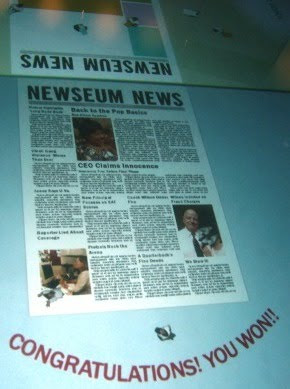
See? I did learn something at that cow college.

A favorite J-school teacher of mine teaching all visitors about ethics.

The floor also offered a suite of cameras for visitors to act as TV reporters. Only one person was doing his live shot when I passed by. I declined an offer to try my hand having done it far too often as an undergrad. The staff member told the visitor that the teleprompter moves at either an adult or child rate. It's too bad the staffer couldn't move the teleprompter as the person spoke because having predefined rates of display couldn't be more wrong. The teleprompter moves as the talent speaks, not the other way around.

Could my nose have been any higher when I, of all people, didn't participate?

The third floor offered a memorial to fallen journalists that should have been more prominent. Tucked in an uninviting corner, it's easy to miss when it shouldn't be. There's also a great display showing how electronic news has changed from the 19th century to today. The panels chronicled advances in radio, TV, and Internet reporting along with events that best represented those advances. It's the exact display you'd expect a history of journalism museum to offer.

Another display tucked away on this floor is one to Edward R. Murrow. Long before his image was abused by every media outlet as a false stamp of approval for talent and whose award is offered in so many categories and market sizes that everyone will win something, he was providing the first live reports from WW2. Murrow's area has poor lighting and takes less space than a display of first family dogs. Priorities, Newseum. Where are your priorities?

A modern control room, but no lessons to be taught. How about explaining what goes on behind the scenes?

The fourth floor was weak. Following the third floor's lead of hiding important exhibits, a gallery on the first amendment was also easy to miss. Seeing as how it's a foundation for all press, more space should be dedicated to this article of the Constitution. Visitors can also see a mock of the late Tim Russert's office. This was very creepy, unenlightening, and clearly done to appease a big sponsor of the Newseum. Nothing is gleaned from Russert's desk.

He did host Meet the Press for many years, but to give his entire office exhibit space is too much for just an interviewer. Russert is not on par with Murrow, the only other journalist receiving such space. The Newseum should have had more displays about the greats of journalism. Another missed opportunity.

The 9/11 gallery was well done and modest with a wall of front pages, the mangled broadcast antenna, and a small theater. I chose to not watch the movie and see those images more often than I need. The Newseum balanced the event's gravity with its technical and logistical impact to NYC TV news.

I would like to see more talk about how 9/11 was the first major news story to test the Internet's capacity to deliver breaking news and how web sites featured abbreviated pages because their servers were slammed. For the first time, TV was no longer the fastest way to get news nor was it everyone's first choice. No longer did I have to wait for TV to tell me breaking news when I could just refresh my browser from many, many sources. It stamped the Internet as my generation's source for breaking stories.

The Newseum's best floor is the fifth floor, home to its collection of historic newspapers. Offering 500 years of newspapers, visitors can pull out drawers of front page copies about major events. Walls are also lined with major objects of journalism history like typewriters and "portable" communication devices. There are also small theaters with documentaries on things like the civil rights movement and the media and Hollywood's depiction of the press.

An exhibit on Woodstock used the 100-foot screen, but I wasn't interested. The exhibit tried to argue that Woodstock was a boon to music reviews, but it was a tough sell.

The history of news panels finished with a small blurb about "Who Controls the News?" It mentions that major companies own media outlets because they're tremendous revenue streams and few of these companies have ties to journalism. The Newseum tiptoed around this so as not to insult its founding partners, but to be true to the craft, more honesty is needed when writing about today's journalism world.

This printer is so so old...it can't even print double-sided, collated, colored, stapled, 3-hole punched, 11x17 copies from a network server off a USB thumbdrive!

Corporations own many media forms, influencing and determining a story's content, angle, and opinion. If the Newseum was honest, it would debate the pros and cons, even finding this to be negative in the changing landscape. Is it too much to ask the museum built to display journalism to not reflect bias in its own reporting? It's only the foundation for the entire ethics center on the second floor.

The final floor offers more front pages from around the world, views of Pennsylvania Avenue, and an exhibit (through February 2010) about Lincoln's assassination. I though this exhibit was well done, telling the story with newspaper prints, showing how journalism actually did impact the event. Curators were just lucky to make this more about the journalism because few artifacts remain; unlike the FBI exhibit that was all artifacts and little about journalism's impact because it had little.

Funny headline mistakes keep you entertained in the bathroom.

The Newseum should change exhibit space to explain how an event becomes a story, much like you'd learn how a bill becomes a law during a visit to Congress. I suggest taking a story like a burning building and show how it's covered in a newspaper, on the radio, on TV, and on the Internet. How do the stories differ? What does each medium offer or lack in trying to tell the story? The Newseum should explain the steps to storytelling, from the assignment editor to the reporter who then talks to sources, firefighters, and neighbors, writing shorthand notes before composing the story.

From there, the story is composed in different styles depending on the medium. How about getting NAT sound for radio or good "B" roll for TV? Maybe a multimedia gallery for the web site? The Newseum should explain how a copy editor proofs a story, how a video editor works with the reporter (in larger markets) to sync pictures with words, and how a radio reporter has to put you at the scene without pictures. How do you overcome each medium's drawbacks?

Finally, with the story ready for publication, the Newseum should explain how an editor lays out a front page, how a producer and director pull together a 30-minute newscast including a much deserving mention to those behind the scenes like cameramen, tape rollers, and the many people in a control room. It's more than just the pretty face on camera that makes it work. The Newseum must dive into the nitty-gritty of journalism and put the visitor in the position to really be a reporter and not just read a teleprompter.

The Newseum already had the satellite truck so why not continue telling the tale of how an event is told as a story?

The Newseum, as I touched on before, must have honest debates about the state of the profession. The big elephant in the room is the public's distrust of the media. There should be talks about how the image of a reporter has eroded so quickly in the last 15 years and what could be done to improve things. The filtering of news through mother company eyes must be out in the open, no matter who pays the electric bills.

Journalism is about honesty so the Newseum should be honest about journalism. Until then, it's as much a building about journalism as it is a glorified modern history museum with newspapers.


Rabu, 02 Desember 2009

Let's play MINGO - Metro Bingo!

It's time for everyone's favorite commuter game...MINGO!

To play MINGO, click on the image below and print your official card. During your Metro rides, cross out the squares that you observe, experience, or hear.

To win, cross out five squares in a row, in a column, or on a diagonal. Then be the first to call out, "Doors opening, step back to allow customers to exit. When boarding, please move to the center of the car." For a greater challenge, try to cross out all of the squares.

It's that easy and fun!

Click the image and set your printer to landscape to print an official MINGO game piece.

Here's the checklist version of MINGO in order of difficulty starting with the most frequent:
  1. Someone runs to catch a train
  2. Early-riser (someone who stands before the train comes to a stop and gains no exiting advantage)
  3. Broken escalator
  4. Loud headphones
  5. Delayed train because of mechanical difficulties or "schedule adjustment"
  6. Passenger loses balance by not heeding conductor advice that train is moving forward
  7. Someone runs to the train only to barely miss it
  8. Seat given as an act of chivalry
  9. Seat given to person in need (blind, crutches, pregnant etc.)
  10. Seat given to a Senior citizen
  11. A stanapper
  12. Tourist can't figure out that a Metro card is pulled out to open the gate

  13. Good luck crossing off #24. It's the most dangerous square.

  14. Poorly designed ad on a train that requires close reading to understand
  15. Obnoxious newspaper reader taking up too much personal space
  16. Station or conductor announcement overwhelmed by a loud beep in the background
  17. Left side of escalator is blocked by someone standing in the way
  18. Dirty looks given to a cougher or sneezer
  19. Someone eating or drinking on a train
  20. Wake a rider at the end of a line's route so he (meaning I) don't ride the train asleep to the railyard
  21. Arm stuck in doors
  22. Someone snores loudly
  23. Burning rubber odor in a station
  24. Leg stuck in doors
  25. Woman applying eyeliner while a train is moving
  26. Parent gets separated from child by closing doors

Selasa, 17 November 2009

How I'd Improve Gas Station Pumps

Why must pumping gas be such an ugly, messy, and industrial affair? I have yet to find a pump that puts the consumer experience first. This needs to change.

I understand that because the nozzle tip is going into a gas tank, it needs to be plain metal, but there's no need for me to see it. I propose adding a retractable outer shell over the metal end that collapses as you put the nozzle into the gas tank. When the nozzle is removed from the tank, the outer shell would re-cover the nozzle and catch gas drops. Just imagine, no more gas drops on your shoes.

The retractable cover is based on advanced collapsible pink cup technology.

The lever that's pulled to allow gas to flow is very unappealing. It's A barren 3-inch metal strip that may or may not lock into position for hands-free pouring. I think there should be a button on the outside that you press once to get the gas flowing. Like its metal brethren, the button would return to its original place when the tank is full. This would make the nozzle piece sleeker.


With my improvements, this won't happen again!

All pump stations should ask if you want a receipt before pumping. There's nothing a driver wants to do less after returning the pump than answer whether or not a receipt is needed. I only want to sanitize my hands after dealing with gas and be on my way. Sure, people could just use gas gloves, but why make the gas pumper purchase protective equipment when that won't be necessary with these changes.

Gas gloves, like this one for U.S. Patent US6643846, won't be needed if I have my way.

With any revolutionary idea like this one, there are some hurdles in the way. There's the cost of designing a prototype, let alone a mass produced version. Building new pumps and retrofitting current models requires hours of work and manufacturing logistics. Selling station owners on the idea is hard because they might have to increase their prices by a few cents. I think customers won't mind the price if it means a guaranteed 100% clean gas pumping experience.

For clean gas pumping you can either hire me as a consultant to implement my idea or drive to New Jersey and Ohio to have someone pump for you. Who says New Jersey isn't high class?